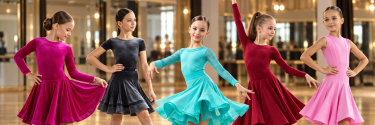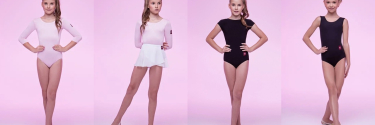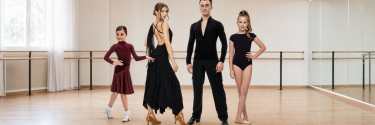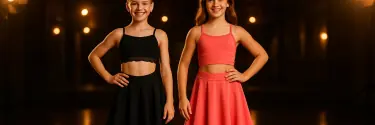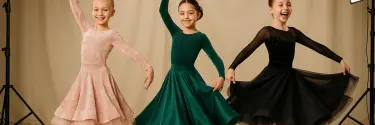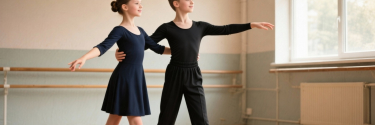
Why Parents Ask This Question All the Time
A girl starts ballroom dancing lessons — and almost immediately the question comes up: what should we buy? The coach says "bring a bodysuit and a skirt," but which bodysuit? Which skirt? And if the child is taking both Latin and Standard classes — which is the most common scenario — parents are completely at a loss.
This guide explains how training wear for Latin and Standard actually differs, what to buy for each program, and how to put together one smart wardrobe instead of two separate ones.
Latin vs Standard: How the Movements Differ
To understand the difference in clothing, you need to understand the difference in movement.
Latin (samba, cha-cha-cha, rumba, paso doble, jive) — dynamic, hip-driven, expressive footwork, open energy. The body is constantly moving, partners separate, the lower body leads.
Standard (waltz, tango, foxtrot, quickstep, Viennese waltz) — partners stay in a closed hold throughout, movement is smooth and sweeping, posture is paramount, upper body and arms define the line.
These physical differences directly determine what the coach needs to see during training — and therefore what your daughter should wear.
Why the Clothing Needs to Be Different
During training, the coach is not just watching — they're reading the body. Every technical detail is visible through clothing: whether the shoulder blades are properly placed, whether the hips are level, what the knee is doing in each step.
If the clothing hides these details, the coach simply cannot see what to correct. The rule is straightforward: training wear should expose exactly what the coach is focused on in each program.
- In Latin, the coach watches the hips, back and legs → an open-back bodysuit and a short skirt that doesn't cover the leg action are essential.
- In Standard, the coach watches the frame, shoulders and body line → a fitted top with a clear shoulder silhouette and a long bottom that shows the step are needed.
Latin Training Wear
Bodysuit or Top: Open Back Is Non-Negotiable
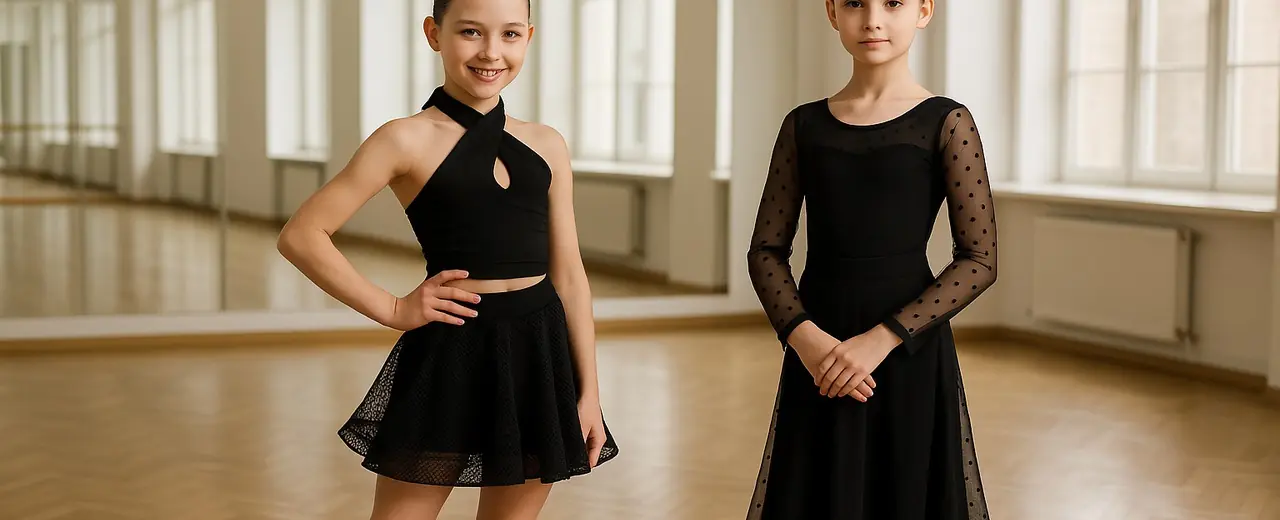
For Latin, a bodysuit or fitted short top with an open back is the right choice. The open back lets the coach see the shoulder blade position, spinal alignment and how the body moves with the hips. If the back is covered, the coach cannot assess or correct the key technical elements.
Best fabrics:
- Bi-flex — the top choice. Thin, close-fitting, resilient, holds its shape through intense movement.
- Oil fabric (matte jersey) — a gentler option for younger girls (under 8): softer, less likely to irritate sensitive skin.
For more on fabric types for ballroom training wear, see our guide: Top 5 Bodysuits for Latin Dance — Comfort and Style for Practice.
Decoration on a training bodysuit: minimal or none. Rhinestones and embellishments are for performances, not for the studio floor.
Skirt: Short and Free-Moving
A Latin training skirt should be short — mid-thigh or above — flared or with ruffles. It should swirl with the body and fully reveal the leg movement. A long skirt in a Latin lesson covers exactly what the coach needs to see.
Fabrics: chiffon, oil fabric, stretchy jersey. The skirt should be lightweight — it shouldn't slow the dancer down or cause overheating during an active session.
Quantity: aim for at least 2 skirts — one in use, one in the wash.
Standard Training Wear
Bodysuit or Top: Clean Shoulder Line
For Standard, a bodysuit can be more covered — with a short sleeve or sleeveless, but with a well-defined neckline. The most important thing: it must hold its shape across the shoulders and not stretch out when the dancer works in the hold with a partner.
Best fabrics:
- Oil fabric (matte jersey) — gives a clean, fitted silhouette and holds its shape in an upright posture.
- Soft jersey — a slightly denser option, excellent for maintaining shoulder line definition.
Skirt or Trousers: Length Matters
There are two equally valid options:
Long training skirt — the classic choice for Standard. It shows the leg line and overall body silhouette in motion. Ideally straight or slightly flared, reaching the ankle or floor. It doesn't need to be full — this is training, not a competition.
Training trousers — an increasingly popular alternative. For Standard: straight or slightly wide-leg cut, full length to the floor. Practical, easy to care for, and they give the coach a clear view of foot placement.
What definitely doesn't work for Standard: sports leggings and tights. They hug the leg too tightly and don't allow the dancer to sense the space in their movement — which is critical for Standard technique.
If Your Daughter Dances Both Programs
This is the most common situation: most children train both Latin and Standard, often in the same session or on the same day. And the first question from parents is: "Do we really need two separate wardrobes?"
Not necessarily. The practical solution is simple:
One neutral bodysuit + two different bottoms.
Choose a bodysuit with a moderate back opening — not fully closed (so it works for Latin) and without a very deep cutout (so it looks appropriate for Standard). Most classic bodysuits with a medium back opening work well for both programs.
Pair it with two different bottoms:
- Short flared skirt → for the Latin part of training
- Long skirt or training trousers → for the Standard part
1 top + 2 bottoms = a complete wardrobe for both programs. Cost-effective and practical.
Quick Reference: What to Buy First
| Item | For Latin | For Standard |
|---|---|---|
| Bodysuit / top | Open back, bi-flex or oil fabric | Closed or semi-closed, oil fabric or soft jersey |
| Bottom | Short flared skirt | Long skirt or straight-leg trousers |
| Fabric | Bi-flex, chiffon | Oil fabric, soft jersey |
| Min. quantity | 2 sets (one in the wash) | 2 sets (one in the wash) |
| Decoration | No rhinestones at training | No rhinestones at training |
What to Avoid at Training
- Sports leggings and tights — the coach cannot see leg and body mechanics. Not suitable for Latin or Standard.
- Loose T-shirts and baggy tops — they hide the back and shoulders, making it impossible to correct posture.
- Rhinestone-decorated bodysuits — they scratch studio floors and can snag on a partner. Rhinestones are for competitions only.
- Cotton clothing — it gets wet, stretches, and loses its shape after a few washes.
- Wrong size — if the bodysuit doesn't sit correctly or the skirt keeps shifting, it's distracting and gets in the way of training.
Where to Find the Right Training Wear
MakGrace carries girls' training wear from DW.DANCEWEAR and SHOK — bodysuits, tops and skirts made specifically for ballroom dance training, in the right fabrics and cuts for both Latin and Standard.
Not sure where to start? Browse the girls' dancewear catalogue or contact us — we'll recommend specific styles for your daughter's age and dance program.
And if she's getting ready for her first competition, read our guide: Ballroom Dress Requirements for Girls: What to Check Before the First Competition.